Introduction
FDT (Field Device Tool) is an open standard for integration of intelligent field devices into process and factory automation systems. It defines a manufacturer- and fieldbus-independent software interface between so-called frame Application and DTM (Device Type Manager). frame Application can be an engineering tool, an asset management system, a DCS system, or any other systems in industrial automation. DTM is a software component for one particular field device type (or sometimes a device family), which contains all the required knowledge to configure, parameterize, or in general control the corresponding device.
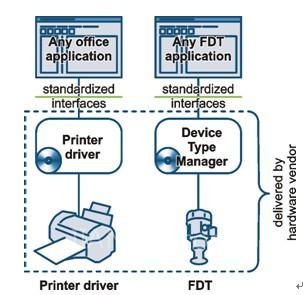
FDT is as easy as using a printer in Windows. Each printer comes with a software driver. After installation, user is able to print in any Windows applications; thanks to the standardized interface between application and printer driver. Just like that. Each field device is bundled with a DTM, provided by the manufacturer. once it is installed, any frame Application is able to load and use the DTM to work with the device! Here, the credit goes to FDT Standard, which defines the interfaces between the frame Application and the DTMs. Figure 1 below gives an illustration for this comparison.
 nload="javascript:if(>500)=500" align=center border=0>
Figure 1: Comparison of Printing and FDT
Merits of FDT | FDT
FDT brings brand new opportunities for both system- and device- vendors, as well as end-users.
1. Free Selection
The FDT standard supports more than 10 fieldbus protocols currently (Figure 2).
 nload="javascript:if(>500)=500" align=center border=0>
Figure 2: Current Support Fieldbuses by FDT
Globally, there are more than 60 device vendors and more than 15 system vendor that already adopted FDT technology with industrial proven products. And FDT’s open architecture allows support of virtually any fieldbus, including proprietary communication protocols. User is able to select the products that most fit to his application. Vendor lockup is no longer possible with this open standard.
2. Investment Protection
FDT technology allows quick extension to the existing fieldbus network. After a few simple steps, your new device is ready to go. The rich user interfaces provided by DTM guides users during the entire device life cycle, including configuration, commission, diagnosis, etc. The device vendor holds the best knowledge about his devices; therefore, DTM provides best functionalities to end-user than any 3rd-party tool. Future protocols in Process Automation and Factory Automation will also be supported by FDT, so investment to FDT brings long-term benefits.
3. Transparent Data Acquisition
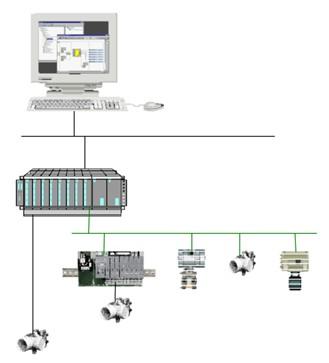
Modern automation system usually consists of complex network hierarchy with more than one fieldbus technologies (Figure 3). Such nested communication and data routing are well-supported by FDT’s innovative communication mechanism. Data from all the devices, regardless of its position in the network, can be transparently retrieved and consumed by different systems.
 nload="javascript:if(>500)=500" align=center border=0>
Figure 3: Hierarchy of Multiple Fieldbuses
4. Ease of Use
FDT enables user to operate large number of devices in a uniformed environment for different functional needs, which reduces costs and effort for training, engineering, diagnosis, maintenance, and so on. The DTM Style Guide, released by FDT Group, defines a uniformed look-and-feel for all user interfaces, which yet offer vast range of unique functionalities. Furthermore, certification and interoperability tests add an extra guarantee for easy plug-and-work.
FDT 2.0
The very first FDT specification was available in 2001, and the current FDT 1.2.1 specification was released in 2005. FDT guarantees to the users its leading position in industrial automation, in terms of technology, functionality, usability and performance. As a commitment to our guarantee, a new FDT version, FDT 2.0, is already on its final stage to become public. It is currently under public review. Interested party can request a copy of FDT 2.0 draft specification from FDT Group. The official release is expected at beginning of 2012.
Since FDT 2.0 is brand new to most of the world, even though it is not officially released, I will be guilty not to share some of its exciting new features with you!
1. Migrate to Microsoft .NET
It has been more than 10 years since FDT first picked its underlining technology: COM and XML. It becomes clear that they cannot fulfill the ever growing demands from the automation industry. On the other hand, the .NET technology receives more attention from its inventor, Microsoft, as well as the software ecosystem. Developers can benefit much better from various development tools and support around .NET technology. And more important, .NET targets exactly the problems we have been facing with the existing technology. It becomes a natural choice to replace the current COM interfaces by .NET interfaces, and to replace XML by .NET data types as arguments used for interface methods.
2. Simplify Architecture and Interactions
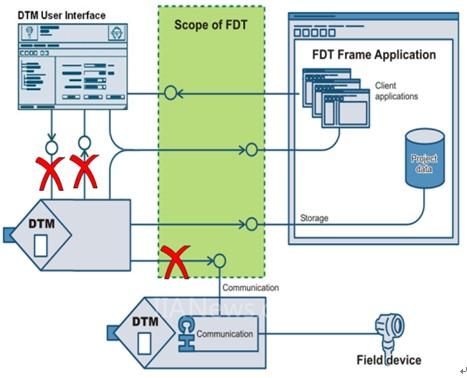
In FDT 1.x, interactions between various components are complex. FDT 2.0’s architecture is dramatically simplified from FDT 1.x. Unnecessary conceptual components and interactions between components are removed (Figure 4).
 nload="javascript:if(>500)=500" align=center border=0>
Figure 4: Simplification in FDT 2.0
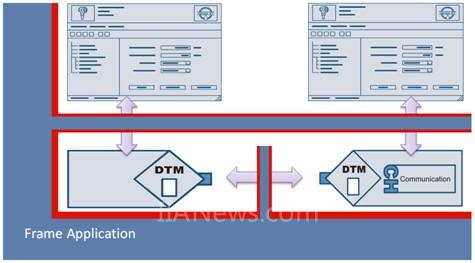
Now the interactions are centralized around frame Application. For example, direct interactions between DTM and its user interface, as well as interactions between DTMs have been taken over by the frame application (refer to the blue area in Figure 5).
 nload="javascript:if(>500)=500" align=center border=0>
Figure 5: Component Interactions in FDT 2.0
This not only simplifies the overall complexity, also avoids various interoperability issues due to inconsistent DTM implementation details.
In addition, the new centralized design also enables distributed architecture for FDT solutions. For example, the frame Application can adopt a client-server architecture. All the DTMs are deployed on a central server in the production site, where the user interfaces can be executed remotely on client side. Best of all, the DTMs and user interfaces don’t even notice this distributed interaction, which opens up a brand new paradigm with unlimited innovation.
3. Better Performance
Performance is always a hot-spot of argument for FDT 1.x. Therefore, it is constantly a constraint when designing the new FDT standard. Concepts like partial loading, fine-grain data access and persistence are the results of such consideration. For example, FDT 1.x DTMs has to take the complete dataset during saving or restoring, even if only a single parameter is changed. When you have a huge DTM topology at actual product site, the initialization takes considerable time. Thanks to FDT 2.0, DTM data is now organized in a more fine-grained manner (with the concept of DataSubSet); therefore, only modified data will be dealt with during saving and restoring. And of course, this is only one of the many performance improvements in the new standard.
Furthermore, with the new .NET technology and the simplified interaction, the overall performance of FDT 2.0 will get an additional boost.
4. Interoperability
The specification document has never been so precise and clear. A well-thought and well-written specification guarantees best interoperability between the resulting products, even from a wide range of vendors. Clear implementation rules, like for multi-threading and synchronization, will probably save developers days of work in order to find out the cause of some deadlock.
It is also decided, for both frame Application and DTM development, a so-called “Common Component” will be designated by FDT Group. Thorough interoperability test will be performed between frame Common Component and DTM Common Component. This guarantees that frame Applications and DTMs that are based on their respective Common Components will seamlessly work together. And the overall testing effort can be reduced dramatically.
5. Backward Compatible
Last by not least, with the new FDT 2.0 standard, long term FDT players can be sure their investments are well protected because FDT 2.0 is backward compatible with FDT 1.x. Huge effort has been devoted to ensuring FDT 1.x DTMs work the same way in the new FDT 2.0 environment.
Oops, did I reveal too much about the new standard? Don’t worry. There are lots of more excitements for you to exploit in FDT 2.0.
Development Tools
 nload="javascript:if(>500)=500" align=right border=0>Since FDT 2.0 adopts Microsoft .NET as its fundamental technology, naturally, Microsoft Visual Studio? and the programming language C# will be the primary tools for FDT development. The latest version, VS 2010, is recommended.
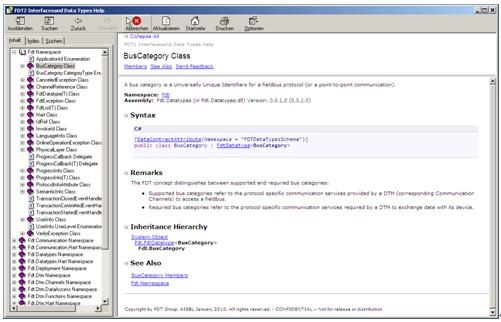
FDT Group will release the .NET interface definitions and .NET data types used by these interfaces as part of the new FDT 2.0 standard. They will be published in the form of .NET assemblies, accompanied with comprehensive online help documentation (Figure 6).
 nload="javascript:if(>500)=500" align=center border=0>
Figure 6: FDT 2.0 online Help
In addition, FDT Group also designated two Common Components, one for frame Application and one for DTM. They encapsulate most FDT 2.0 business logic regarding interactions between different components (e.g., frame vs. DTM and DTM vs. DTM). Developers can then focus more on their application specific functionalities, and still create standard-conforming products. The DTM Common Component is currently under development, while the frame Common Component is already available to the market as beta release.
Future
As of June 2011, 88 international companies in the Factory and Process Automation industries joined FDT Group, and the number is growing fast. In many countries, local FDT teams provide comprehensive support in both technical and marketing area. Activities like roadshow, seminar or formal workshop are organized with the assistance of our FDT members all over the world.
The immediate exciting event is the official release of the new FDT 2.0 standard. Currently, it is under public review, and expected release date is beginning of 2012. The two Common Components will then be available shortly after. First batch of FDT 2.0 compliant products will also hit the market in the near future, and the good news is both FDT 1.x and FDT 2.0 DTMs will work nicely together under the new standard.
Author
Jerry Zhang works at M&M Software (Suzhou) GmbH in the R&D Department. In the past five years, he focused on the development of FDT/DTM solutions. He is the chairman of Technical Working Group of China FDT Association (CFA), the local FDT Organization in China.